Redesigned Detail Pages, Archival Overhaul, Pipedrive, Salesforce, HubSpot & HiBob...
At a Glance
Redesigned project detail page — Tab-based layout with an embedded timeline, inline financial summary on the planning tab, rate visibility, cost card details, and more
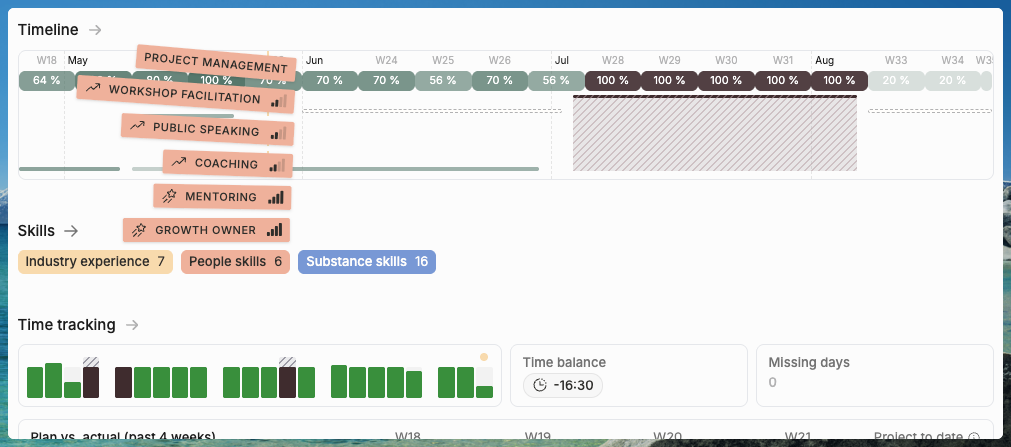
Redesigned person & client detail pages — My own Timeline, time tracking visuals and planned vs actuals comparison, skills, project history…
Expense improvements — CSV import for expenses, expense filtering in burnup charts, "cost in project currency" export option
Archival overhaul — Properly hide archived entities across all views, selectors, filters, groupings, and timelines — with a "show archived" toggle when you need them
HubSpot field mapping — Deal amount as default budget, manually set the latest deal, multi-deal handling, and fewer accidental tag creations
Pipedrive v2 — New public Pipedrive integration app
BETA: Salesforce app — Already usable, pending AppExchange publish. Reply to this email if you’d like to set it up!
Project-specific task polish — Archive tasks, convert shared tasks to project-specific, clearer UI for task management
Timesheet fixes — Mobile duplicate entry fix, small improvements here & there
MCP server reliability — Auth fixes for MS Copilot and other clients, pagination fix for time entries, scaled-up infrastructure due to high demand
Quality of life — Utilization excludes pre/post-employment periods, portfolio CSV export in tenant currency, invoicing pre-checks, and a long list of bug fixes
BETA: Forecasted revenue in portfolio reports — Blend actuals-to-date with adjusted future plans, with a configurable cutoff date, across all billing types
Redesigned Project Detail Page
The project detail page has been completely rebuilt using a tabbed layout. The goal: get to the information you need without scrolling past everything else.
For example, the Team tab shows the info you need:
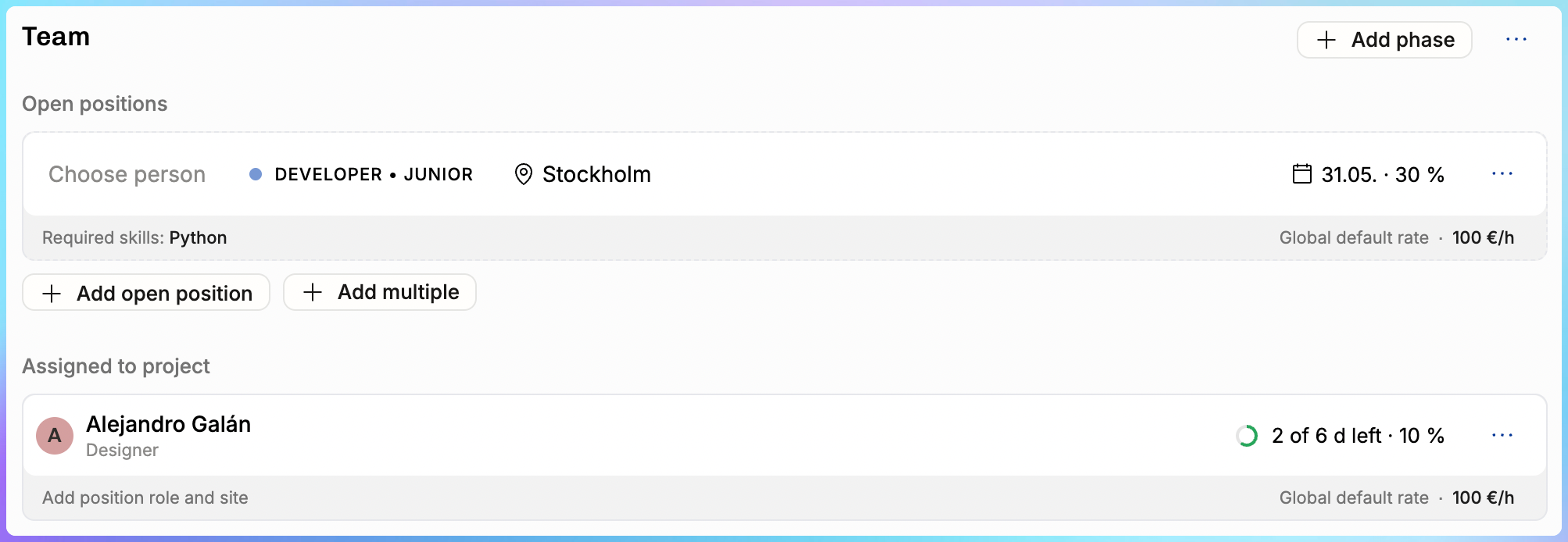
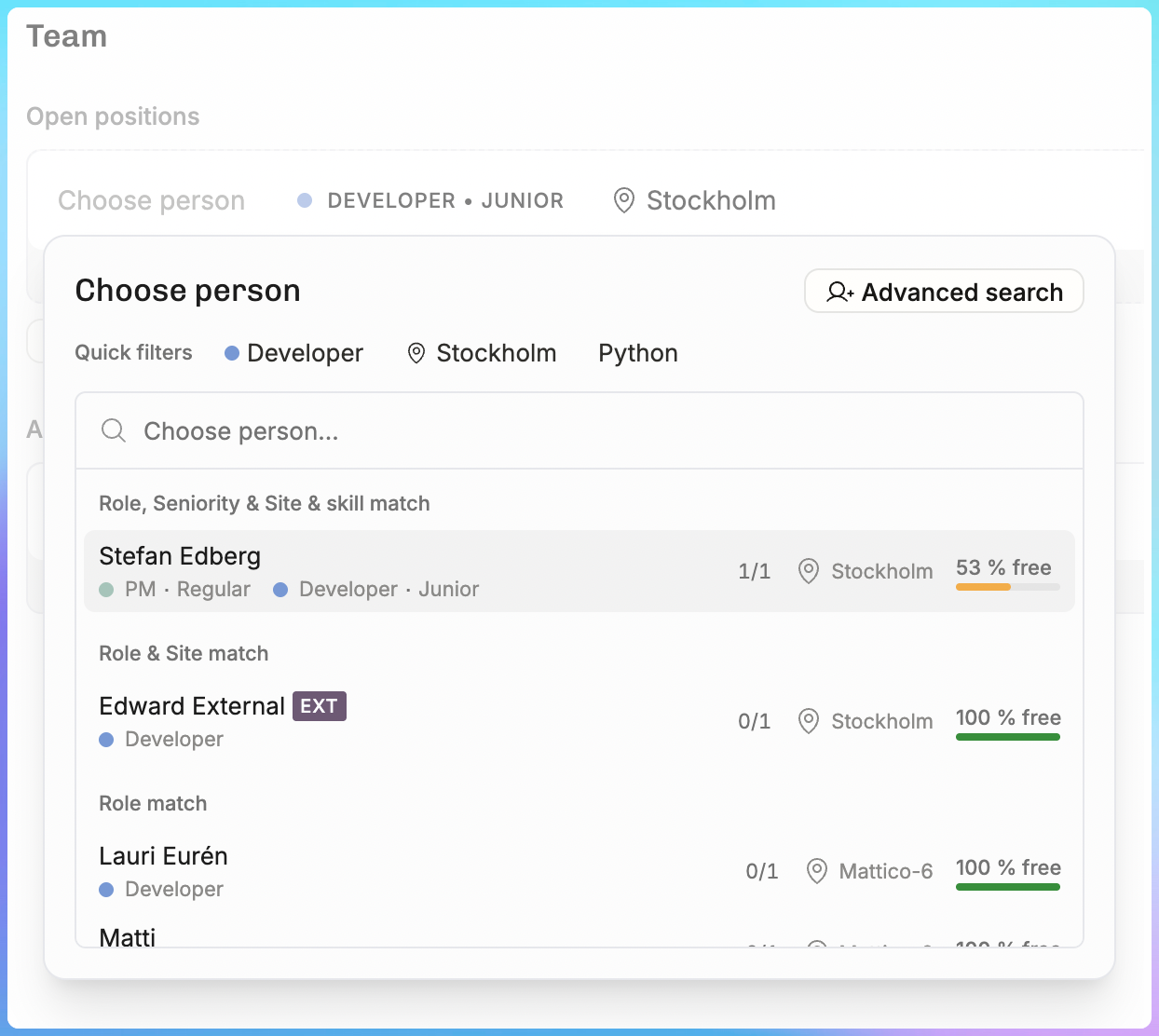
New person suggestion UI. Just try it, it’s super neat.
Embedded timeline. The planning tab now includes a full interactive timeline — the same one you'd see on the staffing views, but scoped to this project. Add positions, drag allocations, manage phases — all without leaving the project page. The “Fit to screen” zoom option is delightful.
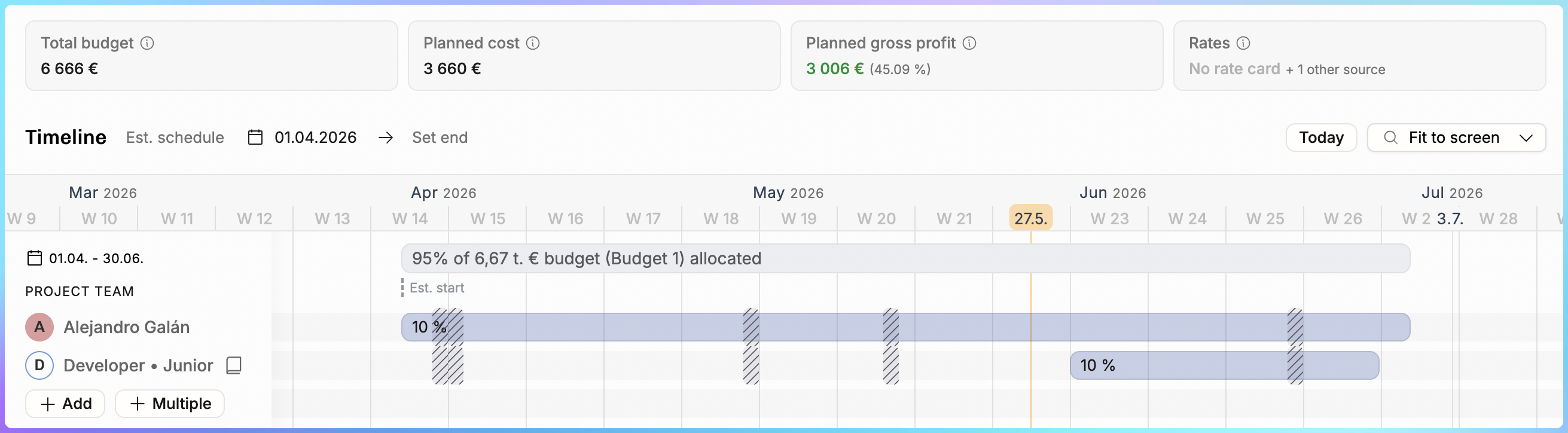
Financial summary on the planning tab. Rate and revenue data is now visible directly in the planning section. You can see billing rates, planned vs. actual revenue, and project financials without switching to a separate tab. This is especially useful during staffing decisions where financial impact matters.
Cost card visibility. The person detail page now shows which cost card applies to each person and the effective hourly rate — calculated from their monthly or weekly cost rate, accounting for the actual number of working days in each month.
Setup completeness indicators. The overview tab flags when something hasn't been configured — missing billing type, no budget, no positions. This helps catch setup gaps before they become reporting gaps.
UI polish. Long project and client names no longer break the top bar layout. Allocation descriptions that were getting clipped now display properly. The timeline no longer accidentally expands beyond two years in edge cases.
Thank you all who opted in for this feature early on, your feedback has helped us so much!
Person & Client Detail Pages are new, too
These pages have also been rebuilt with a tabbed layout.
The person details has a powerful overview that actually tells you what they’re up to, more about the status of their time tracking and project history:
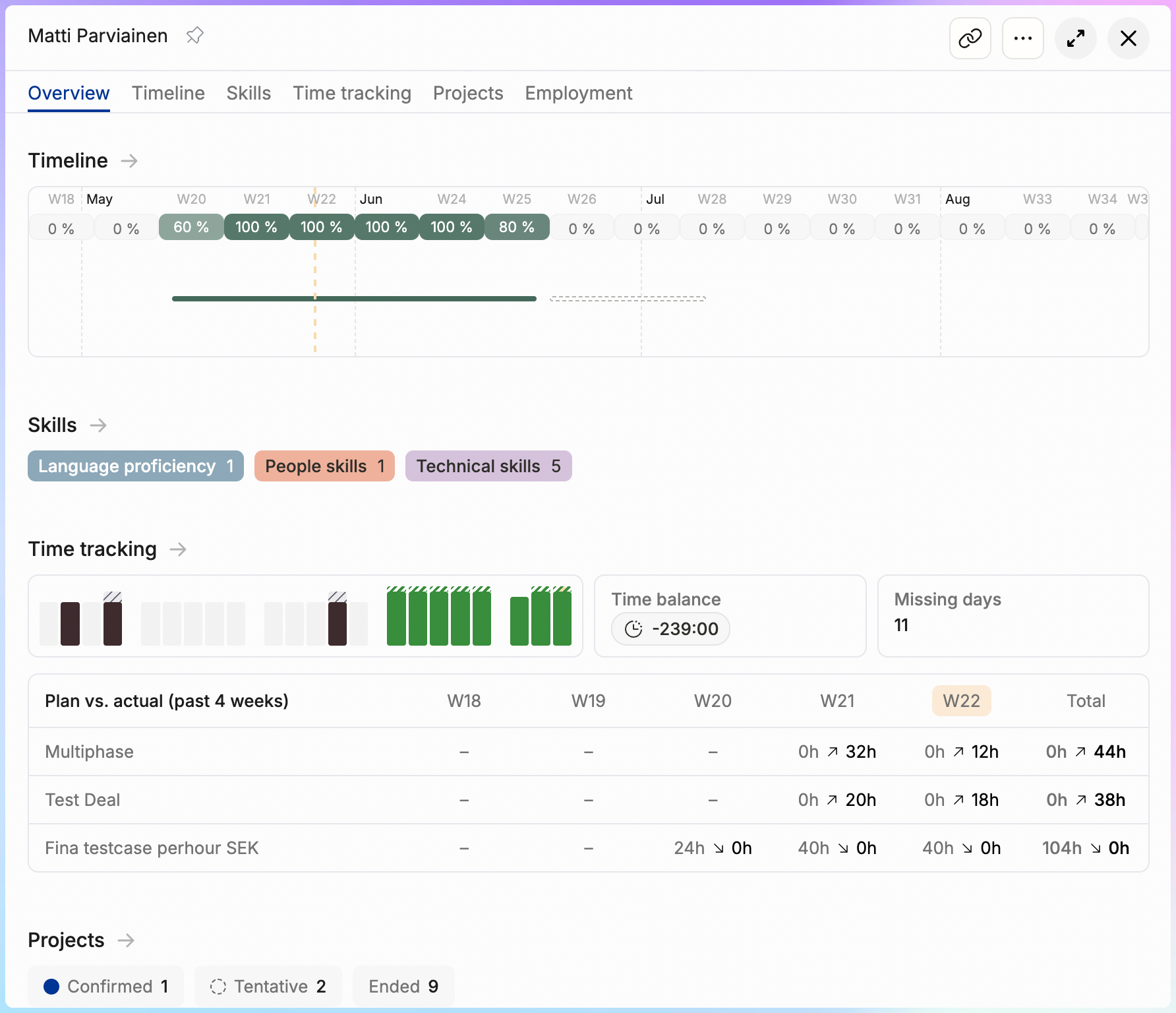
Take a look at your own profile or some of your colleagues! I bet you’ll find something surprising in there: things that were in Operating all along but hidden behind one click too many.
Client details is still a stub (Matti hopes to grow it to a sweet account management app).
BETA: Forecasted Revenue in Portfolio Reports
The portfolio report can now show forecasted numbers — a blend of what has actually happened with what's still planned.
Four new report units. Forecasted revenue, forecasted costs, forecasted gross profit, and forecasted margin %. These sit alongside the existing planned and earned units.
Configurable cutoff date. Choose where actuals end and plans begin — start of the current month, start of the week, or a custom date. Changing the cutoff triggers a re-fetch so numbers update immediately.
Works across all billing types. T&M projects sum actuals and plans directly. Capped T&M respects the budget ceiling. Fixed-price projects scale remaining planned periods so the total always equals the contract budget exactly — no rounding drift. The calculation handles mid-month cutoffs precisely by splitting periods at the boundary rather than approximating.
This is the foundation for Estimate at Completion (EAC) reporting across Operating. Let us know if you’d like to use this already today. We’re still ironing out the details and making sure it handles all expenses and corner-cases reliably.
Expense-related Improvements

Building on the expense management system from the previous release. Again, if you find yourself continuously importing or manually entering expense data, let us know. The “importer V3” effort lays the foundation for many great uploading features.
BETA: Expense CSV import. Import expenses from external systems via CSV — useful for migrations and for organizations managing expenses in other tools. Multi-line-item expenses are supported, with expense-level fields repeated per row.
Expense filtering in burnup charts. The burnup chart's person filter now includes an "Expenses" card. Click it to isolate expense actuals vs. plans in the burnup, with the same +/- comparison that person cards show. This makes it possible to track expense budget burn visually.
"Cost in project currency" in expense exports. Previously only a display option — now available as a column in CSV exports.
Archival Overhaul
Archived entities have been comprehensively cleaned up across the entire app. This was one of the most-reported sources of confusion — archived people, projects, groups, and roles showing up in places where they shouldn't.
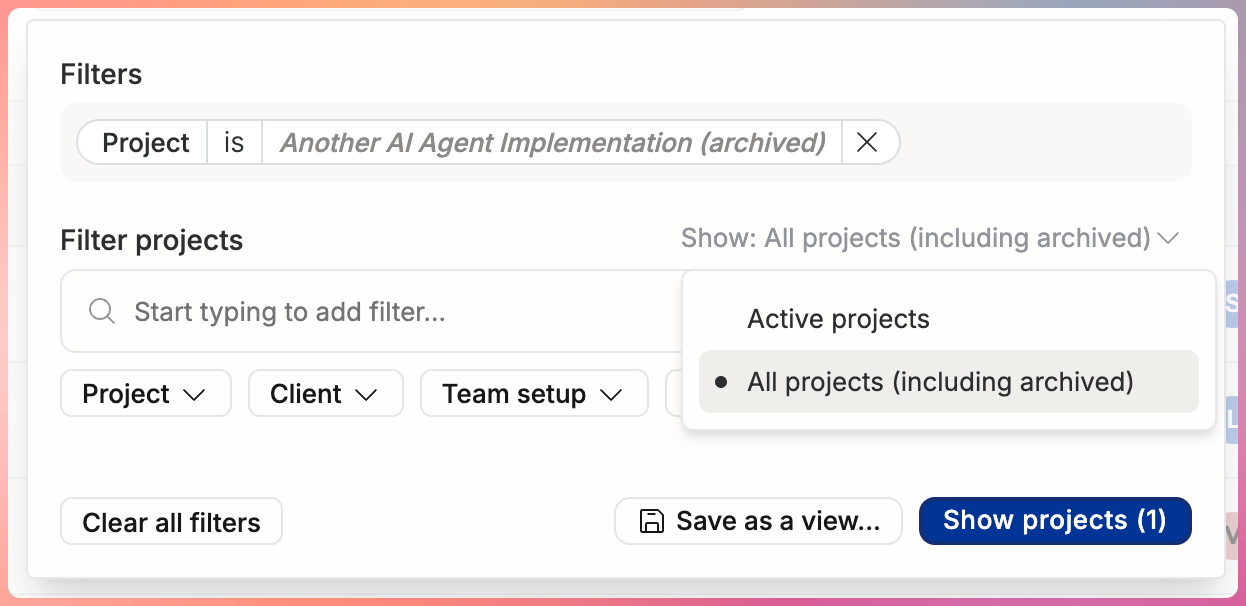
Archived items hidden from selectors. Person selectors, project selectors, group dropdowns, role dropdowns, and filter lists no longer show archived items by default. When an archived item is the current selection, it still appears (with greyed-out italic styling) so you can see what's set without losing context.
"Show archived" toggle on lists. People, projects, and client lists now have explicit controls for including archived items. Search results indicate when archived matches exist and offer to show them.
Archived items hidden from groupings. When you group lists by role, group, seniority, or tags, archived categories no longer appear as grouping headers — even if some items still reference them.
Timeline cleanup. Archived projects no longer appear on the people timeline in collapsed view. Time-off shadows now display correctly for people whose employment started or ended outside the visible timeline range.
Filter fixes. Filtering by "Role: none" no longer incorrectly returns people with roles. The "Team member: Me" filter no longer includes projects where your position has been archived.
Consistent archived styling. Archived items across all views — reports, rate cards, currencies, expense categories, tags — now use consistent italic + grey + "(archived)" suffix styling.
HubSpot & HiBob Field Mapping
HubSpot / Pipedrive deal amount as default budget. When a deal syncs from the CRM and creates a project, the deal amount is now used as the default project budget. Project start and end dates also map from the deal.
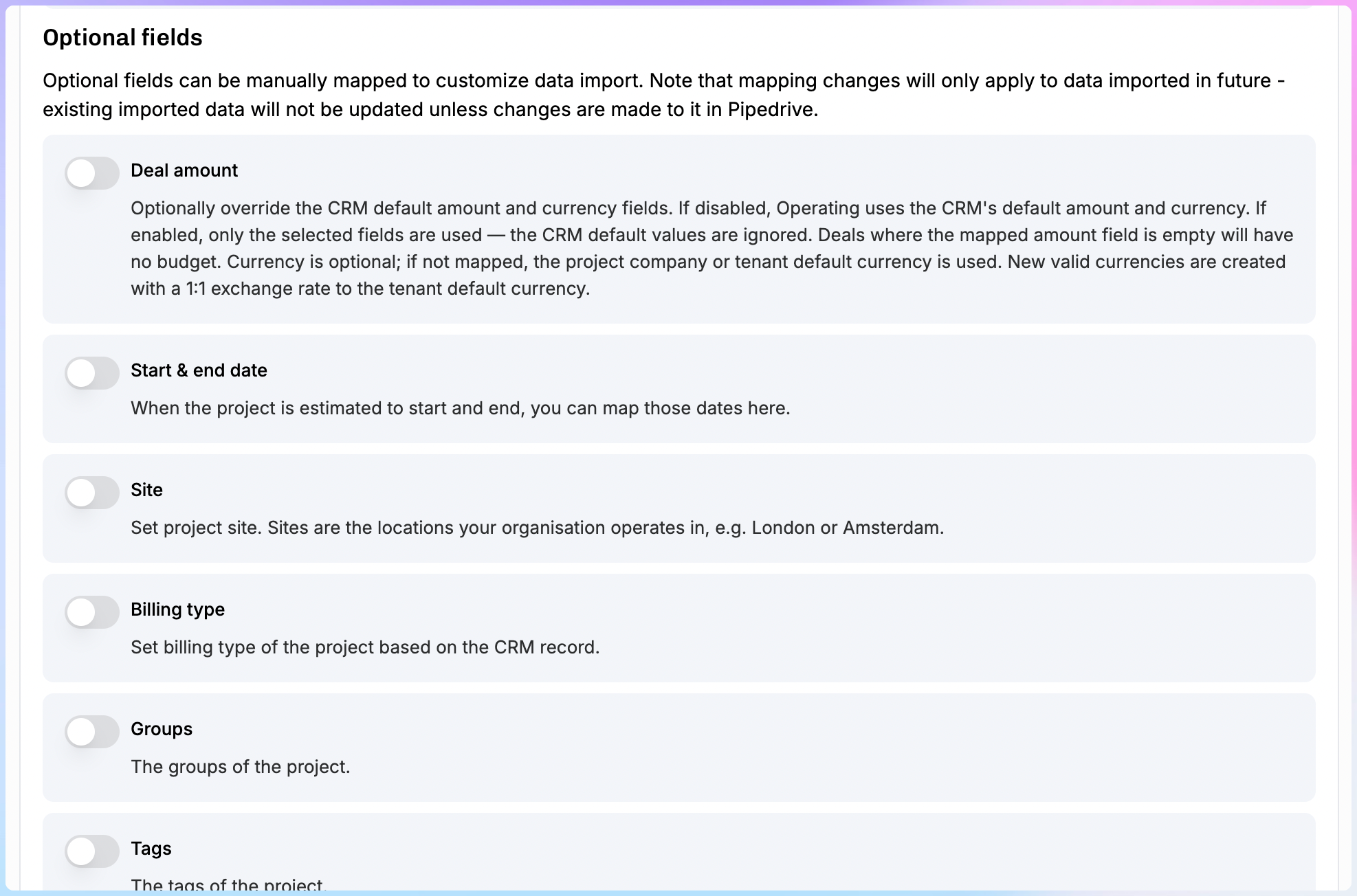
Manually set the latest deal. When a project has multiple linked deals, you can now explicitly set which one is the "latest" — the one that defines the project's probability. Previously this was automatic and sometimes wrong.
Project-Specific Task Polish
Following up on the Tasks 2.0 launch.
Archive vs. delete. Project-specific tasks can now be properly archived (if they have time entries) or deleted (if they don't). Previously, deleting was the only option, which left "No Task" entries in reporting.
Convert shared to project-specific. Transform a shared task into a project-specific one. Also: clear the "reported as" field when it's no longer relevant.
Cleaner task UI. The task assignment popover clearly marks project-specific tasks. "Billable in this project" has been simplified to "Billable." The archived tasks list is hidden by default with a "Show archived" button. Task rate inputs only appear when task-based rates are enabled.
Unset tasks in bulk edit. When a project no longer has active task assignments, you can now bulk-clear the task field from time entries — removing references to archived tasks.
Timesheet Fixes
Mobile duplicate entry fix. On mobile browsers (iOS Safari and Firefox), adding a time entry would create two entries instead of one. This long-standing bug has been fixed with a comprehensive rewrite of how the timesheet handles position and task combinations across all scenarios.
Correct planned hours with time off. The weekly planned hours bar and summary now correctly deduct time off from project allocations. Previously, if you had vacation overlapping a project allocation, the planned hours showed the sum of both — inflating the number beyond your actual working hours.
Consistent time-off display across timelines. The people timeline and project timeline now show the same capacity percentage when allocations overlap with time off. Previously, one view would stack them (showing >100%) while the other correctly subtracted.
Time-off day count consistency. The allocation popover now shows consistent time-off day counts regardless of which timeline you're on. Holiday calendar days and individual time off are now counted the same way everywhere.
Shift+click multi-select. Hold shift and click a checkbox to select everything between it and the last checked box. Works in time entry approval lists and other list views.
MCP Server Reliability
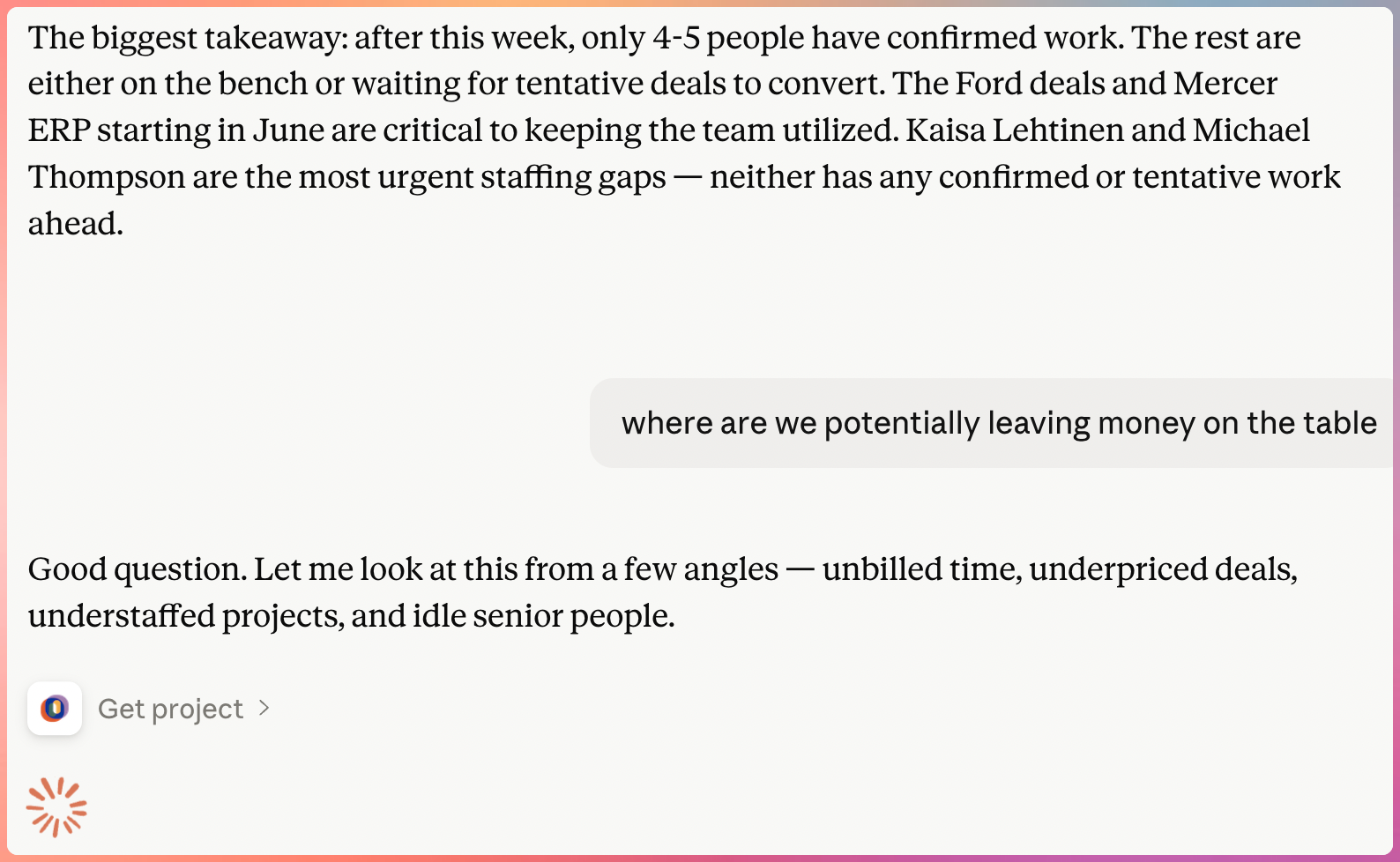
Auth fixes for third-party clients. The OAuth discovery document now includes grant_types_supported with authorization_code and refresh_token, fixing "Invalid Compact JWS" errors that prevented MS Copilot and other MCP clients from connecting. Microsoft doesn’t seem to play nice with the MCP standard, but let’s keep hope alive.
Scaled-up infrastructure. MCP server CPU, memory, and task count have been increased. The network architecture has been simplified, reducing costs while improving reliability.
Pipedrive v2
The rebuilt Pipedrive integration is now available as a public app. The new version brings real-time sync, better field mapping, and direct deal-to-project linking. Existing Pipedrive users will need to disconnect and reconnect — see the migration email for details.
Salesforce v0.99
Not published in AppExchange yet – if you’re sitting on the blue ☁️ and Operating, reply to this email and we’ll get you connected out-of-the-box.
Quality of Life & Bug Fixes
Utilization excludes pre/post-employment. Utilization averages now exclude periods before a person's start date and after their end date — so someone who joined mid-quarter isn't penalized with months of zero utilization dragging down their average.
Portfolio CSV export in tenant currency. Export the project portfolio CSV in your organization's default currency instead of per-project currencies. A currency column is included in each row when exporting in money units.
Additional bug fixes: Name whitespace showing "undefined," projected cost tooltip showing total instead of delta, duplicate archived tasks appearing in timesheets, API schema incorrectly exposing externalId on project create/update, client bulk-delete returning 500 when invoices exist, and HubSpot webhook signature validation fixes.
We’re extremely happy to have Matias on board. He’s been crushing bugs 360°.
That’s enough for today. Eid Mubarak to those who celebrate.