QuickBooks Online accounting
Connect a QuickBooks Online company to an Operating company, so your invoices and credit notes go to QuickBooks and their status and payments come back.
Written By Mikko Karjalainen
Last updated About 20 hours ago
What the QuickBooks Online integration does
The QuickBooks Online integration connects one Operating company to one QuickBooks Online company. Operating sends your invoices and credit notes to QuickBooks, and QuickBooks sends back their status and the payments recorded against them.
Invoices in QuickBooks refer to QuickBooks' own tax codes, products and services, and customers. So the integration also brings those records into Operating and links each one to its counterpart in Operating.
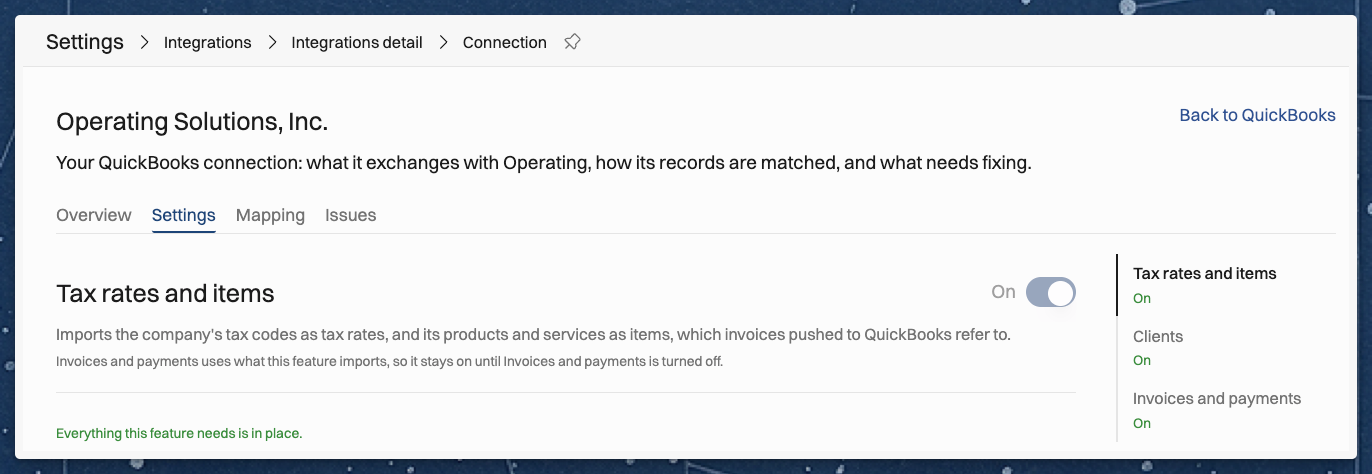
The integration has three features. You turn each one on separately on the connection's Settings tab:
Tax rates and items: imports the company's tax codes as tax rates, and its products and services as items, which invoices pushed to QuickBooks refer to.
Clients: imports the company's customers as clients, and creates in QuickBooks the clients an invoice pushed to it needs.
Invoices and payments: creates Operating's invoices and credit notes in QuickBooks, and brings back their status and their payments. It needs the other two features to be on.
What syncs, and in which direction
QuickBooks keeps the linked tax rates, items and clients up to date in Operating. Edit their details in QuickBooks, because the next import replaces a change made to them in Operating.
Operating imports tax codes, items and customers when you turn a feature on, and then every day. It reads the status and payments of each invoice that is not settled yet as soon as QuickBooks reports a change, and every 6 hours.
A company in the US imports no tax rates, because QuickBooks works out US sales tax itself. Its invoices go to QuickBooks without tax rates, and QuickBooks adds the tax.
Before you start
In Operating, you need:
The Manage integrations permission to connect QuickBooks, change its settings and map records. See Permission sets in Operating.
The right to edit the invoice (the Manage invoices permission) to save an invoice to QuickBooks.
An invoicing currency on the company you connect. Without it, the Invoices and payments feature shows "Set the company's invoicing currency in Operating."
In QuickBooks Online, you need:
An admin of the QuickBooks company. Only an admin can connect an app. If that person later loses the admin role, the connection stops until an admin reconnects it.
Multicurrency turned on if you invoice in a currency other than the company's home currency.
Custom transaction numbers turned off if QuickBooks is to number your invoices.
How to connect QuickBooks Online
Go to Settings > Integrations and open QuickBooks. The page lists each of your Operating companies.
Next to the company, click Connect to QuickBooks.
Sign in to QuickBooks, choose the QuickBooks company, and allow Operating's access.
Operating opens the connection's Settings tab. Nothing is imported until you turn on a feature.
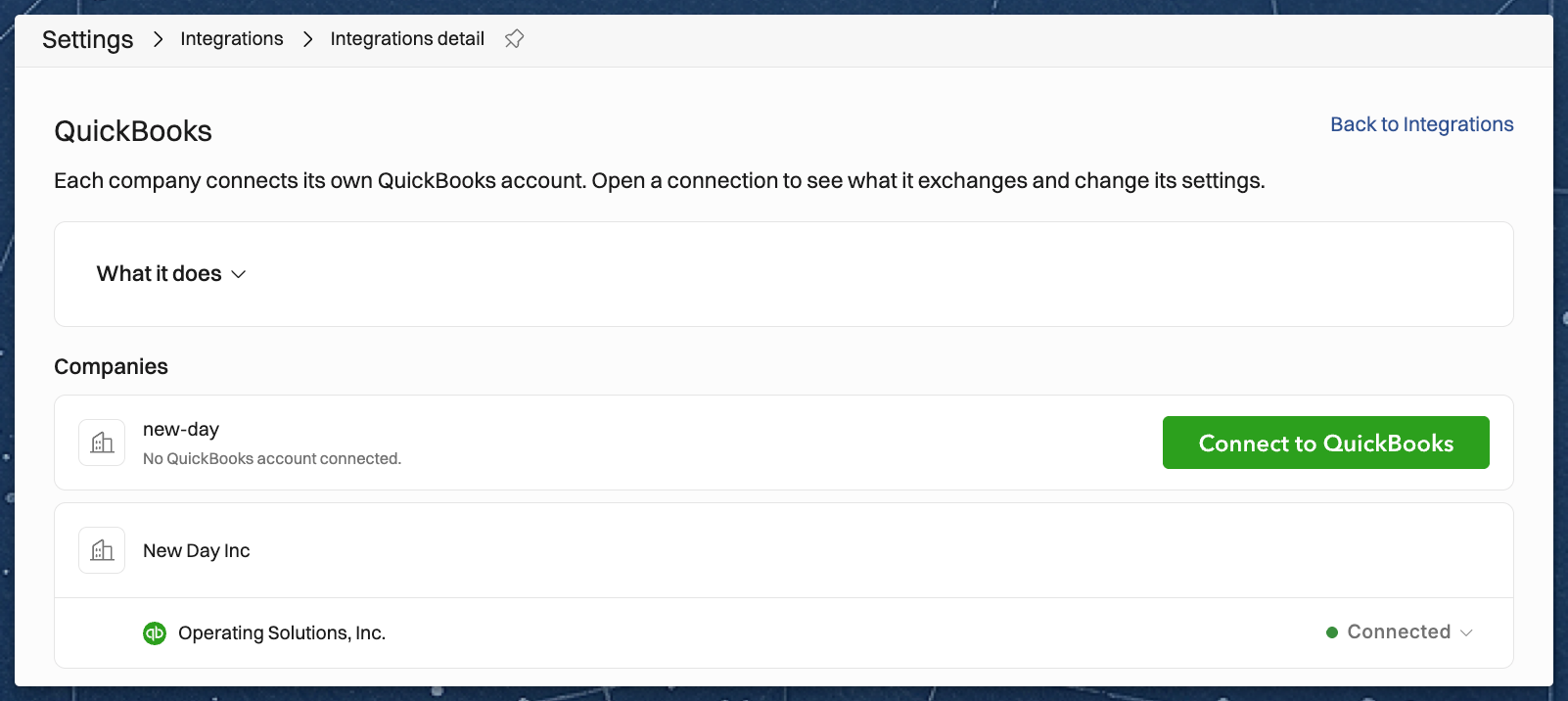
You can connect each QuickBooks company to one Operating company. To invoice from several companies, connect a separate QuickBooks company for each.
How to set up the features
Turn the features on in two rounds, because Invoices and payments can be turned on only after its tax rates and items are mapped.
On the Settings tab, turn on Tax rates and items and Clients.
Check each feature's settings. The settings are listed below.
Click Save changes. Operating imports the tax codes, items and customers.
Map the imported records on the Mapping tab, as the next section says.
On the Settings tab, turn on Invoices and payments, check its settings, and click Save changes.
A feature that cannot be turned on yet says why, and its readiness checks list what blocks it. For example: "3 billable items still need to be mapped."
How to map tax rates, items and clients
The Mapping tab links each record imported from QuickBooks to a record in Operating. It has a tab for each record type, such as Tax rates, Billable items and Clients, with the number of records still unmapped.
On the Mapping tab, open Tax rates.
For each record under To do, do one of these:
Click Accept to link it to the record Operating proposes.
Click Link to existing and choose the Operating record.
Click More and choose Create a new tax rate, or Ignore.
Click Commit decided tax rate mappings. Nothing changes in Operating until you commit.
Do the same on Billable items and Clients.
To decide on many records at once, select them and click Create new, Accept proposals or Ignore.
Operating proposes links where it finds a match, such as a client with the same VAT ID, invoicing email or name. Once no client is left unmapped, Operating creates a client for each new QuickBooks customer, unless it matches a client Operating already has.
Map your existing clients before you send the first invoice. Operating does not look for an existing customer when it saves a client to QuickBooks. QuickBooks refuses the new customer when another one has the same name.
Settings
Each feature's settings are on the Settings tab, under the feature. Click Save changes to save them.
What is imported:
Items to import: Items QuickBooks sells, the default, or Every item, which adds the products and services you only purchase.
Customers to import: Top-level customers, the default, or Customers, sub-customers and jobs, each as a client of its own. QuickBooks projects are never imported as clients.
A customer with an address Operating cannot store: an address in Operating needs a street line, a postal code, a city and a country. Choose Import the client without that address, the default, or Leave the client out until the address is fixed in QuickBooks.
Records made inactive or archived:
A tax code made inactive in QuickBooks: Archive it, the default, or Keep it active.
An item made inactive in QuickBooks: Archive it, the default, or Keep it active.
A customer made inactive in QuickBooks: Archive it, the default, or Keep it active.
A client archived in Operating: Make the customer inactive, the default, or Keep the customer active. With Keep the customer active, nothing is sent for an archived client.
Customers Operating creates:
Currency of a customer Operating creates: applies only while multicurrency is on in QuickBooks. A QuickBooks customer's currency never changes. Choose The currency it is invoiced in, the default, or The company's home currency.
Numbers and tax:
Tax decided by and Item for lines without one: these show their values and cannot be changed. Each line carries the tax rate mapped in Operating, except in a US company, and each line needs a billable item.
Invoice numbers come from: Operating, the default, or QuickBooks. You can change it only until the first invoice is saved to QuickBooks.
Status from QuickBooks:
An invoice posted in QuickBooks: QuickBooks posts an invoice the moment it is created. Mark it sent in Operating, the default, so its payments follow. Or Leave it for Operating to mark sent.
A document deleted in QuickBooks: Void it, the default, or Keep it. Either way, the document is not saved to QuickBooks again.
How to send an invoice to QuickBooks
Create the invoice in Operating as usual. See How to create and send an invoice. Give every line a billable item that is mapped to a QuickBooks product or service.
Open the invoice.
Click Save to QuickBooks. It is the invoice's main action until the invoice is in QuickBooks.
When the save succeeds, Operating shows "Saved to QuickBooks." The Accounting row of the invoice then shows QuickBooks · Synced with the invoice's number in QuickBooks. Click it to open the invoice in QuickBooks.
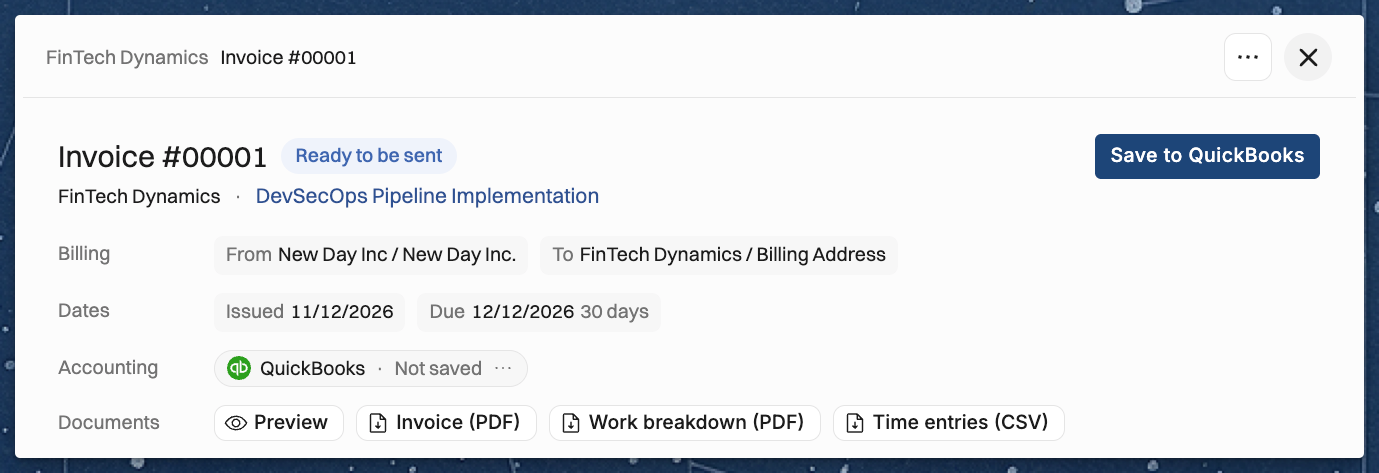
When Operating saves an invoice:
Client: if the client is not in QuickBooks yet, Operating creates its customer first.
Posting: QuickBooks posts the invoice at once, so it is on the company's books as soon as you save it. With the default setting, Operating marks it sent.
Lines: each line goes with its product or service and its mapped tax code.
Number: the invoice keeps Operating's number, unless your settings let QuickBooks number it.
Currency: while multicurrency is on, the invoice goes to the client's customer in the invoice's currency. When the client has no customer in that currency, Operating creates one named after the first, such as "Acme GmbH (EUR)".
If you edit the invoice after you save it, the page shows "Changes not in QuickBooks yet." Click Update in QuickBooks to send the change. QuickBooks does not change a paid, voided or deposited invoice, or one in a closed period. Then Operating keeps the invoice as QuickBooks booked it and shows "QuickBooks kept it as booked, as it no longer lets it change."
To send a credit note, issue it in Operating, open it, and click Save to QuickBooks. Operating saves the invoice it credits first, if that invoice is not in QuickBooks yet. QuickBooks receives a credit memo, and Operating applies it to the invoice for as much as the invoice still owes.
How status and payments come back
QuickBooks is where the invoice is paid, and Operating follows:
Paid in QuickBooks: Operating adds each payment to the invoice, and marks the invoice paid once QuickBooks reads it paid. The invoice's Activity shows Payment received with the amount.
Payment voided or deleted in QuickBooks: Operating voids the payment on the invoice.
Voided in QuickBooks: Operating marks the invoice voided.
Deleted in QuickBooks: Operating voids the invoice, with the default setting.
Money a payment leaves unapplied, and refunds of a credit memo, are not imported.
To read an invoice's status and payments right away, open the Accounting row's menu and click Refresh from QuickBooks.
How to disconnect QuickBooks Online
Go to Settings > Integrations and open QuickBooks.
Next to the QuickBooks company, click its status, Connected, and choose Disconnect….
Click Disconnect QuickBooks to confirm.
You can also disconnect from the connection's Overview tab, under Danger zone.
Disconnecting stops every import, push and scheduled run, and Operating gives up its access to the company. Mappings and settings are kept, so connecting the same company again continues where it stopped.
If someone disconnects Operating from inside QuickBooks, the connection shows Needs reconnecting the next time it syncs. Click Reconnect to connect it again.
Common errors and how to fix them
When a save or an import fails, the invoice's or the client's page shows the message. The connection's Issues tab lists every failed record with what fixes it. After you fix the cause, click Retry on the issue, or Retry saving to QuickBooks on the invoice.
These are the messages you are most likely to see:
"The QuickBooks user who connected the company is no longer its admin. Reconnect QuickBooks as an admin." Reconnect as a QuickBooks admin.
"The QuickBooks company is read-only because its subscription has lapsed. Renew it in QuickBooks, then retry." Renew the subscription in QuickBooks.
"This account is already connected for another company." The QuickBooks company is connected to another Operating company. Disconnect it there first, or connect another QuickBooks company.
"A line has no billable item, and QuickBooks ignores the amount of such a line." Choose a billable item for each line of the invoice, then retry.
"Another customer, vendor or employee in QuickBooks already has this name. Rename one of them, then retry." When the customer is the client's, link the client to it on the Mapping tab, then retry.
"Another document in QuickBooks already has this number. Change one of the numbers, then retry." Change the number in Operating or in QuickBooks.
"The date falls in a period whose books are closed in QuickBooks. Change the date, or reopen the period in QuickBooks, then retry." Change the invoice date, or reopen the period.
"QuickBooks leaves documents unnumbered while custom transaction numbers are on in this company." Turn off custom transaction numbers in QuickBooks, then retry.
"The document is in {currency}, which QuickBooks does not use for this company." Turn on multicurrency in QuickBooks, or invoice in the home currency.
"The client's customer in QuickBooks is in {customer currency}, and this document is in {invoice currency}; QuickBooks never changes a customer's currency." Invoice the client in its customer's currency, or set Currency of a customer Operating creates to The currency it is invoiced in.
"QuickBooks will not make this customer inactive while it has an open balance." Settle or credit the customer's open invoices in QuickBooks, or make the client active again in Operating.
"A record this one refers to is inactive or missing in QuickBooks. Make it active there, or map another, then retry." Make the item, tax code or customer active in QuickBooks, or map another one.
Related articles
Was this helpful?
Still need help? Ask the team